TABLE OF CONTENTS
- Introduction
- Components
- Screening Decision Logic Generator
- Decision Logic Executor
- Human-in-the-loop oversight and accountability
Introduction
Laser AI supports full-text screening through two connected AI components: the Screening Decision Logic Generator and the Decision Logic Executor.
The Screening Decision Logic Generator translates the review’s eligibility criteria into an operational decision structure. The Decision Logic Executor then applies this structure to the full-text documents and provides evidence-linked suggestions for individual screening questions and the overall eligibility decision.
Together, these components connect the review protocol with the assessment of full-text publications. The project team defines and approves how the eligibility criteria should be applied, while the model supports their consistent execution across documents.
Components
The full-text screening workflow includes:
Screening Decision Logic Generator, which converts eligibility criteria and protocol requirements into structured screening questions and decision rules.
Decision Logic Executor, which evaluates full-text documents against the approved decision logic and provides suggested answers, rationales, highlighted evidence, and overall decision hints.
Unlike title and abstract screening, this workflow does not include the Record Prioritization or Abstract Structuring models.
Screening Decision Logic Generator
Review protocols usually describe eligibility criteria in narrative form. Although this is appropriate for documenting the review methodology, the criteria may still require interpretation when applied to individual full-text publications.
This becomes particularly important at the full-text stage, where reviewers may need to assess detailed information about the population, intervention, comparator, outcomes, study design, publication type, follow-up period, or other project-specific requirements.
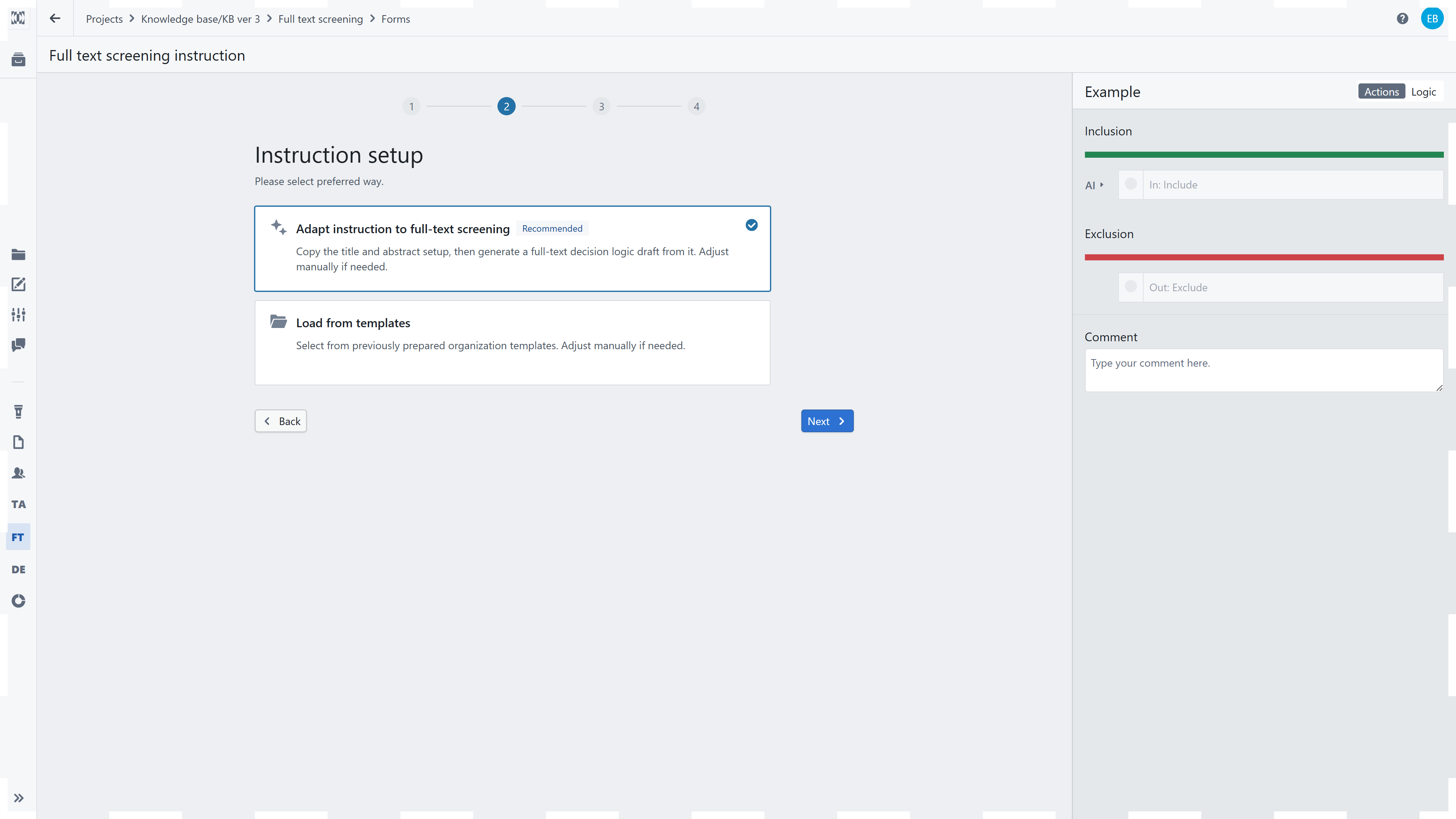
The Screening Decision Logic Generator converts these criteria into a structured and operational screening instruction. It decomposes the criteria into individual screening questions and defines how the answers should lead to inclusion, exclusion, or an unresolved outcome.
The resulting workflow is:
The protocol defines which studies are eligible.
The Decision Logic Generator translates the eligibility criteria into operational screening questions and decision rules.
The project team reviews and refines the generated draft.
The Decision Logic Executor applies the approved logic to full-text documents.
No prompt engineering required
Reviewers do not need to write, test, or optimize prompts. They provide the eligibility criteria in the same methodological language used in the review protocol, and the Screening Decision Logic Generator handles the prompt construction required to produce the draft decision logic.
The reviewer’s task remains methodological: to verify that the generated logic correctly represents the protocol, refine it where necessary, and approve it before screening begins. Subject-matter and evidence-synthesis experts can therefore configure AI-assisted screening without having to become prompt engineers.
Structure of the decision logic
Well-designed full-text decision logic should:
address one eligibility concept in each screening question;
use wording that can be interpreted consistently;
specify how Yes, No, and Unclear answers affect the screening outcome;
connect exclusion outcomes with the appropriate exclusion reasons;
distinguish missing or unclear information from information that confirms ineligibility;
reflect what can reasonably be determined from the full-text document.
The order of questions also matters. A record may be excluded as soon as one question satisfies an exclusion rule. Criteria that can determine eligibility clearly and efficiently may therefore be assessed earlier, while questions requiring more detailed interpretation may appear later.
Generating and reusing decision logic
For a new project, the first draft can be generated from the eligibility criteria entered by the project team. Alternatively, an existing organizational template can be reused and adapted.
Templates can support consistency across projects with similar review questions while still allowing project-specific modifications.
The generated output is a draft and should undergo methodological review. The project team should verify that:
all eligibility criteria relevant to full-text screening are represented;
questions reflect the intended interpretation of the protocol;
decision pathways lead to the correct inclusion and exclusion outcomes;
exclusion reasons are mapped appropriately;
ambiguous or insufficiently reported information is handled as intended.
The approved logic should be tested on a representative sample of full-text documents before the main screening begins. This calibration exercise can reveal unclear wording, missing decision pathways, or criteria that require additional guidance.
A shared framework for reviewers and AI
Once approved, the decision logic provides a common framework for reviewers and the Decision Logic Executor.
Reviewers can see the questions applied by the model, examine its suggested answers and supporting evidence, and evaluate the overall decision hint against the same operational criteria.
The model therefore does not provide an isolated eligibility prediction. It applies a review-specific decision structure that has been reviewed and approved by the project team.
Decision Logic Executor
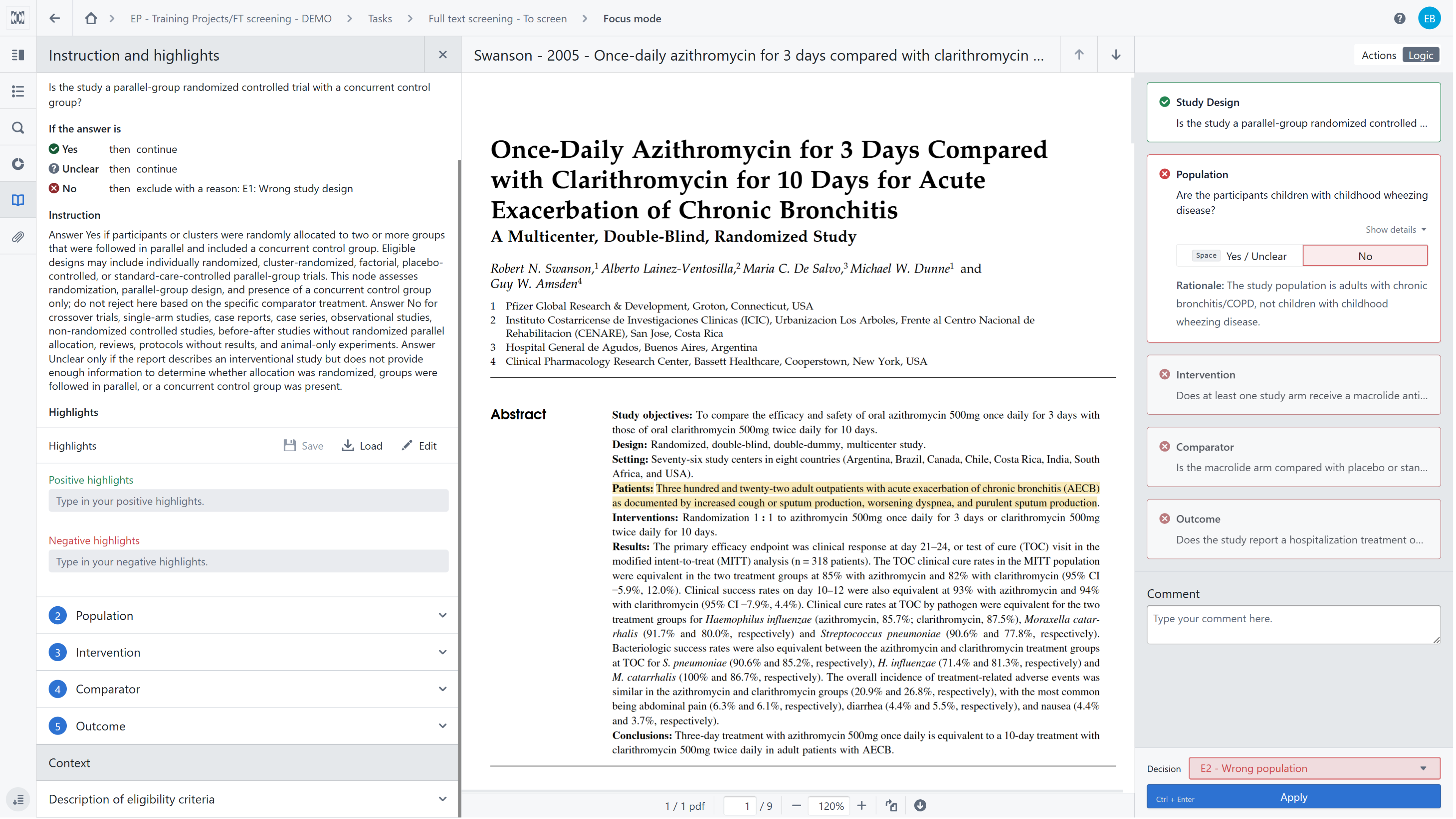
The Decision Logic Executor applies the approved decision logic to each full-text document. It evaluates the available document content against every screening question and provides structured, evidence-linked suggestions to support the reviewer’s assessment.
For each screening question, the model provides:
a suggested answer, such as Yes, No, or Unclear;
a rationale explaining how the available information was interpreted;
highlighted passages from the full-text document supporting the suggested answer.
Selecting a screening question opens its details, including the model answer and rationale. The corresponding evidence is highlighted in the document, allowing the reviewer to compare the recommendation directly with the source text.
Based on the question-level answers and the approved decision logic, the model also provides an overall AI decision hint, such as Include, Exclude, or No prediction.
The reviewer should examine the suggested answers, rationales, and highlighted evidence before assigning the final decision. The reviewer can follow or override the AI recommendation.
Filtering records using model outputs
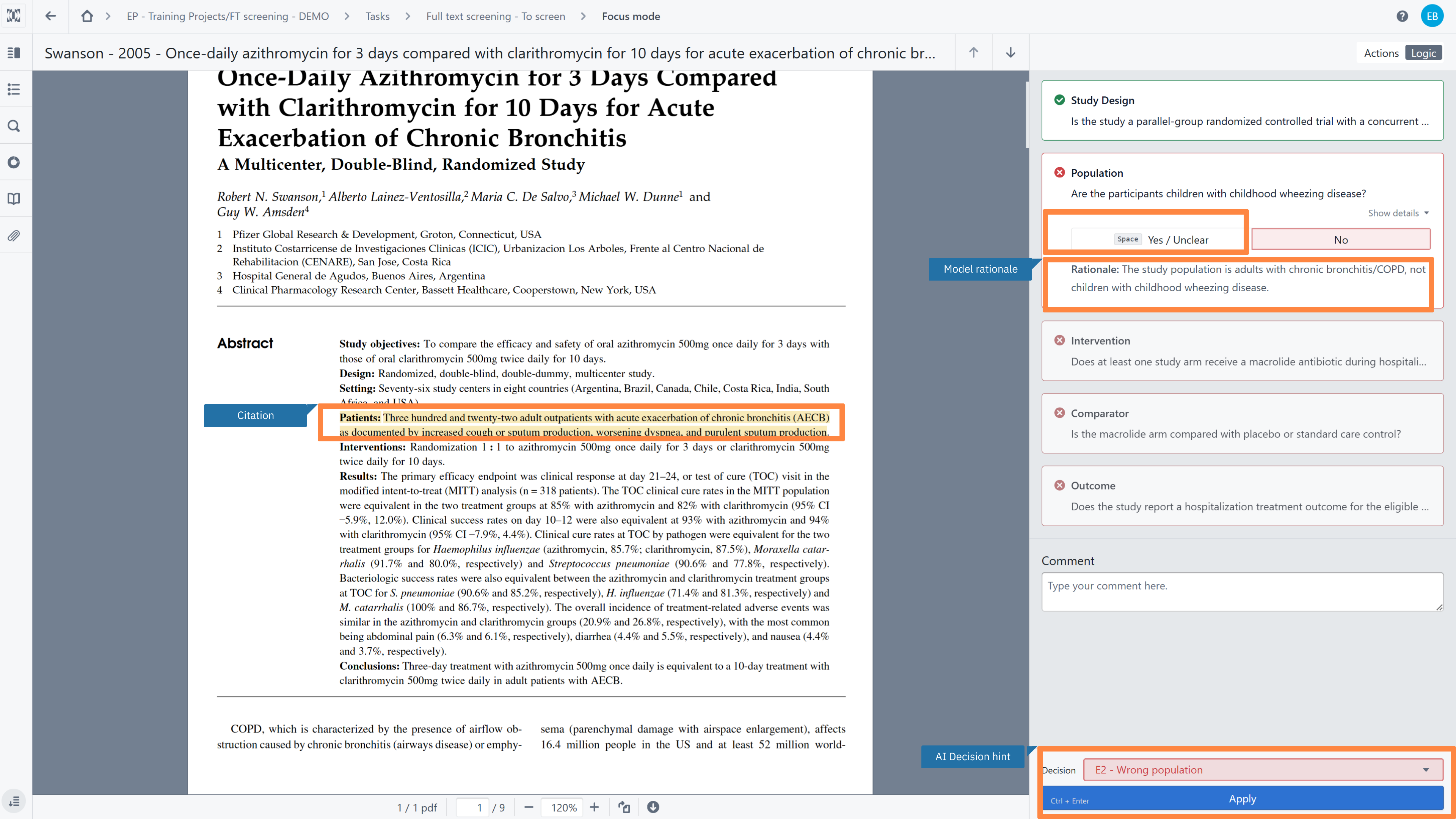
The Reference List allows records to be filtered at two levels:
AI suggestion – the overall decision hint for the full-text record;
Decision logic answers – the model’s answers to individual screening questions.
AI suggestion
The AI suggestion filter groups records according to the overall model recommendation, such as Include, Exclude, or No prediction.
Because the decision logic is applied iteratively, an Exclude suggestion may be triggered by the first question that satisfies an exclusion rule. The overall suggestion represents the outcome of the decision logic and should not be interpreted as a summary of all question-level answers.
Decision logic answers
The Decision logic answers filter allows reviewers to select a specific screening question and display records according to the model’s answer to that question.
This filter can be used to:
review full-text records associated with a particular eligibility criterion;
examine how the model interprets the same criterion across multiple documents;
assess similar records consecutively;
identify questions that frequently receive Unclear answers;
identify difficult or insufficiently reported cases for discussion;
support calibration of the decision logic.
Filters can also be combined with other Reference List filters. The resulting records can be reviewed individually or selected for batch acceptance of AI suggestions.
Batch acceptance may be appropriate in workflows that permit a higher level of automation, such as exploratory evidence searches or selected rapid and scoping review workflows. Before using it, the project team should:
confirm that batch processing is consistent with the review protocol;
validate the decision logic on a representative sample;
define an appropriate quality assurance procedure.
For systematic reviews requiring human verification of every eligibility decision, reviewers should continue to assess each full-text record individually.
Human-in-the-loop oversight and accountability
Human oversight applies at both stages of the workflow:
For the Screening Decision Logic Generator, the project team reviews, refines, tests, and approves the generated decision logic.
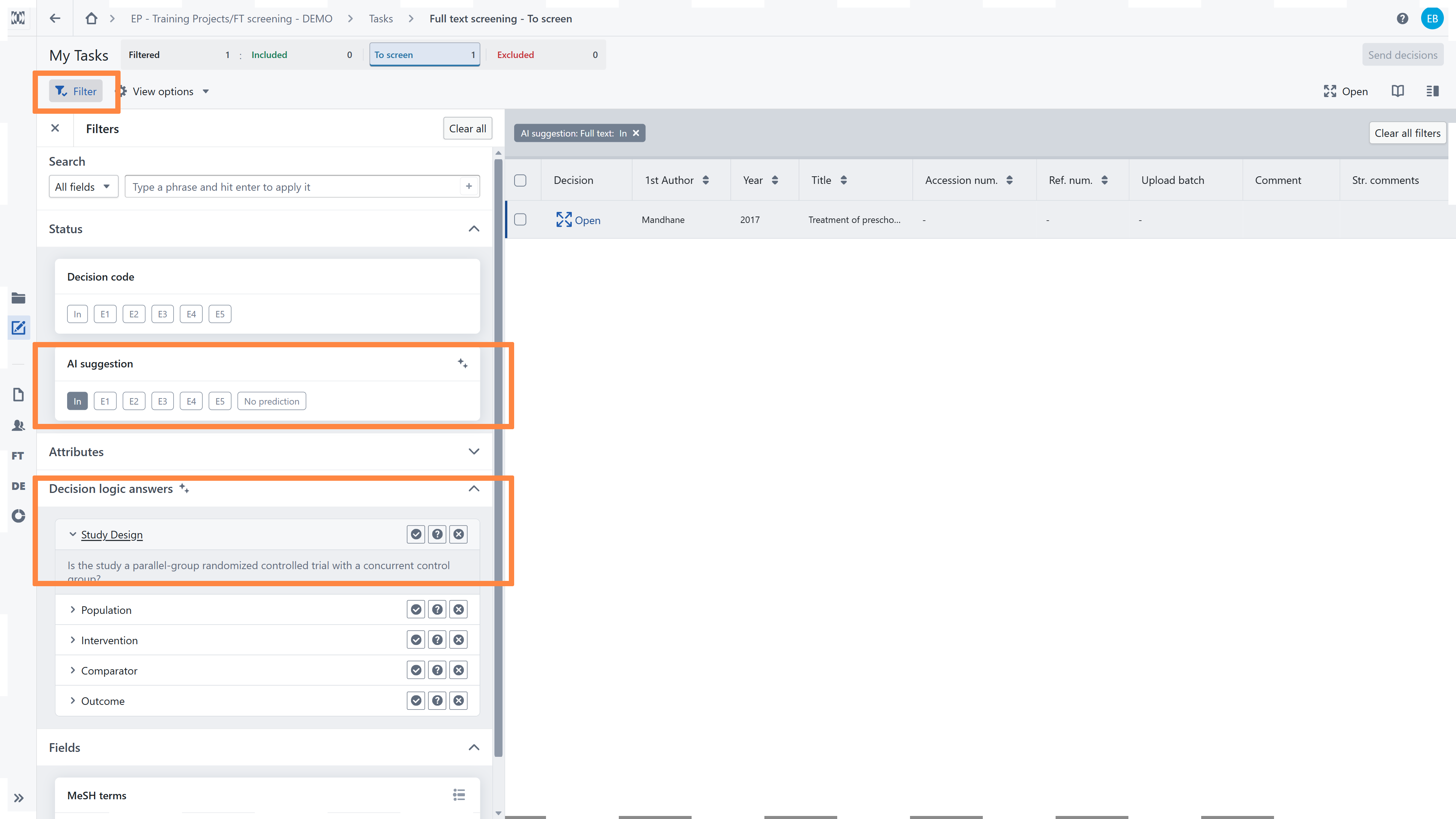
For the Decision Logic Executor, reviewers evaluate the suggested answers, rationales, highlighted evidence, and overall decision hint before making the final eligibility decision.
The evidence supporting each model answer is linked to the relevant passage in the full-text document. Reviewers can therefore examine how the recommendation was generated and determine whether it appropriately reflects the protocol and the information reported in the publication.
The model supports the application of the eligibility criteria, while reviewers retain methodological oversight and responsibility for the final full-text screening decisions.
Was this article helpful?
That’s Great!
Thank you for your feedback
Sorry! We couldn't be helpful
Thank you for your feedback
Feedback sent
We appreciate your effort and will try to fix the article