Conducting evidence synthesis, often involves repetitive, time-consuming tasks: screening thousands of records, extracting data from PDFs, identifying duplicates, and managing references. Laser AI is designed to streamline these processes by combining the speed of AI with human oversight.
Laser’s design philosophy ensures that users stay in full control. Each Laser AI module integrates Human in the Loop (HITL) principles, allowing the system to handle repetitive or large tasks while keeping human reviewers responsible for the final decisions.
Here’s how HITL works across the main stages of the Laser workflow:
| Stage | AI-Assisted Component | Human Oversight and Actions | Outcome |
|---|---|---|---|
| Deduplication Stage | The system detects and flags potential duplicate records, grouping them into clusters based on the estimated probability of duplication. | Users validate or override model suggestions, or manually identify additional duplicates as needed. | Efficient removal of duplicates with full user control. |
| Screening Stage | During the Title and Abstract (TiAb) screening process, the model ranks records according to their likelihood of meeting inclusion criteria, prioritizing the most relevant items first. | Users make all final inclusion/exclusion decisions, regardless of ranking. | Faster review throughput while preserving expert judgment. |
| AI-Generated References | When PDFs lack references, the model generates bibliographic information automatically. | Each AI-generated reference must be individually reviewed and approved by the user. | Streamlined reference creation with guaranteed accuracy. |
| AI-Supported PDF Upload | The model automatically matches uploaded PDFs to corresponding references during bulk uploads. | Users may manage single uploads, or manually replace mismatched files. | Smooth document management with complete oversight of reference alignment. |
| AI-Supported Text Extraction | The model suggests values for text-based data extraction fields, directly connect to their source location in the PDF. | Users can accept, modify, or reject suggestions — either in batch or individually. | Human-verified extraction ensures both speed and reliability. |
| Controlled Vocabularies (Vocabs) | The model identifies and extracts relevant text passages or values directly from the publication. | Users interpret each extracted value and map it to the appropriate standardized term in the organization controlled vocabulary. | Standardized outputs aligned with project and organization vocabularies. |
| AI-Supported Table Extraction Module | AI-Supported Table Recognition: The system detects tables and identifies their structure (cells). Human Mapping: Users map table elements to the Data Extraction Form (DEF) fields. AI-Supported Extraction: The system extracts table values into the DEF. Human Validation: Users review, correct, or reject extracted values. | Human review is mandatory for batch-extracted data and optional for single-value extractions. | A true semi-automated, HITL workflow combining precision and flexibility. |
Now, let's deep dive into particular stage in which HITL approach in Laser can be useful
Case study #1 - Extraction from tables

A human-in-the-loop (HITL) approach is essential for reliable table extraction because tables are often complex, inconsistent, and context-dependent.
In Laser, AI can efficiently detect tables, recognize their structure, and extract values to the form, human expertise ensures that the extracted data is correctly interpreted and mapped to the right Data Extraction Form (DEF) fields. Human review and validation help catch ambiguities, formatting issues, and edge cases that automated systems may miss, especially in non-standard tables.
What are steps of human-AI collaboration in table extraction?
- First, the system automatically detects tables in the document and recognizes their structure, such as rows, columns, and cells.
- Next, users map the identified table elements to the appropriate fields in the Data Extraction Form (DEF), providing context and intent that guides the extraction.
- The AI then extracts the table values according to this mapping.
- Finally, users review the extracted data, validating, correcting, or rejecting values as needed.
Case study #2 - Controlled vocabularies
In Laser AI, fields in the Data Extraction Form can be connected to vocabularies, so that the extracted values can be presented as a predefined term from a list. When AI model is extracting data, it's also able to match the extracted term to those from the vocabulary.
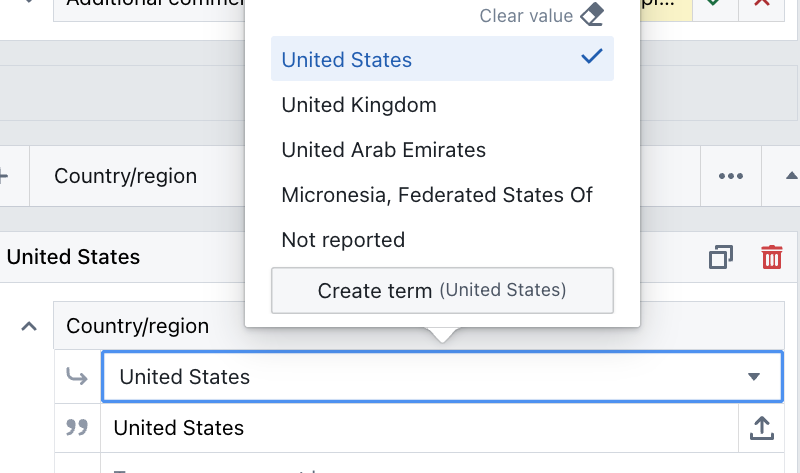
However, in some cases, the term may not be available in the vocabulary. In that cases, it's possible to add additional term to the vocab.
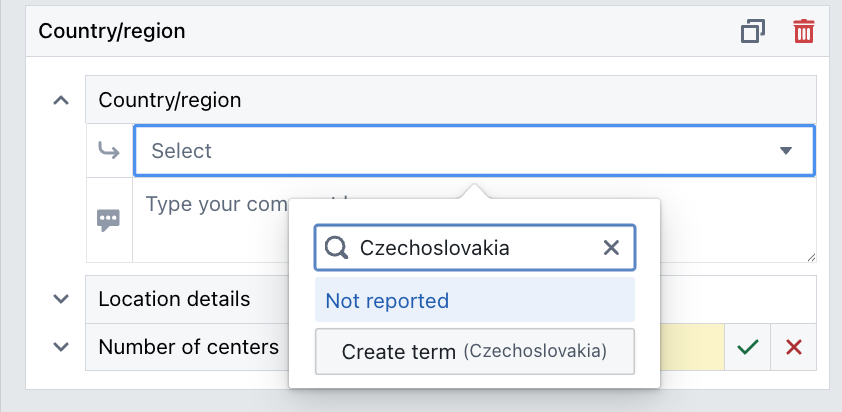
In the next step, suggestions are reviewed on the project level and only then go to the organization level. User responsible for the project management can check if new terms should be added to vocabulary or are duplicates of already added terms, correct typos and map terms.
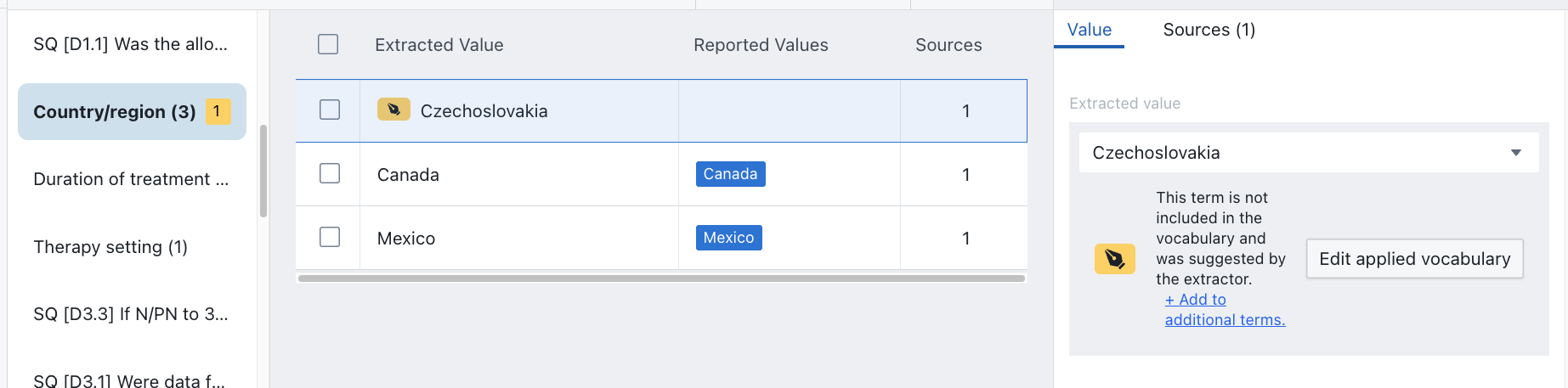
This workflow is an interesting example for AI-human collaboration, because even though model extract the data in the field, reviewer is responsible for making decision about the extracted term and the final look of the vocabulary
Was this article helpful?
That’s Great!
Thank you for your feedback
Sorry! We couldn't be helpful
Thank you for your feedback
Feedback sent
We appreciate your effort and will try to fix the article